Journal ·
Moissanite vs. diamond: an honest comparison
Moissanite and diamond look alike at arm's length, and both are hard enough to wear every day. They are still two different gemstones. Here is what actually separates them, with the numbers behind it.
What moissanite is
Moissanite is crystalline silicon carbide. Henri Moissan found the first tiny crystals in 1893 in the Canyon Diablo meteorite crater in Arizona. Natural moissanite is so rare that every moissanite sold today, including ours, is created in a lab. It is not a diamond simulant made of glass or cubic zirconia: it is a gemstone with its own optical and physical properties.
Fire: the rainbow flashes
Fire is how strongly a stone splits white light into colours. Gemmologists measure it as dispersion. Moissanite has a dispersion of about 0.104, diamond about 0.044. That is why moissanite shows bigger, more colourful flashes, especially in sunlight or under spotlights. If you love that rainbow sparkle, moissanite gives you more of it. If you prefer a calmer, whiter sparkle, diamond is closer to that.
Brilliance: the white light
Brilliance depends on the refractive index. Moissanite's is 2.65–2.69, diamond's 2.42. Light bends more sharply inside moissanite, so a well-cut round brilliant sends a lot of it back through the top of the stone.
Hardness and everyday wear
On the Mohs scale moissanite scores 9.25, just below diamond's 10 and above sapphire's 9. In practice that means it resists scratches from everyday life and keeps its polish. It is also tough and heat resistant, so it does not cloud over time.
Colour and size
Modern lab-grown moissanite is near-colourless. Because moissanite is a little lighter than diamond, stones are best compared by size in millimetres rather than carats: a 6.5 mm round moissanite has the same diameter as a 1 carat round diamond, a 5 mm stone that of about 0.5 carat.
Price
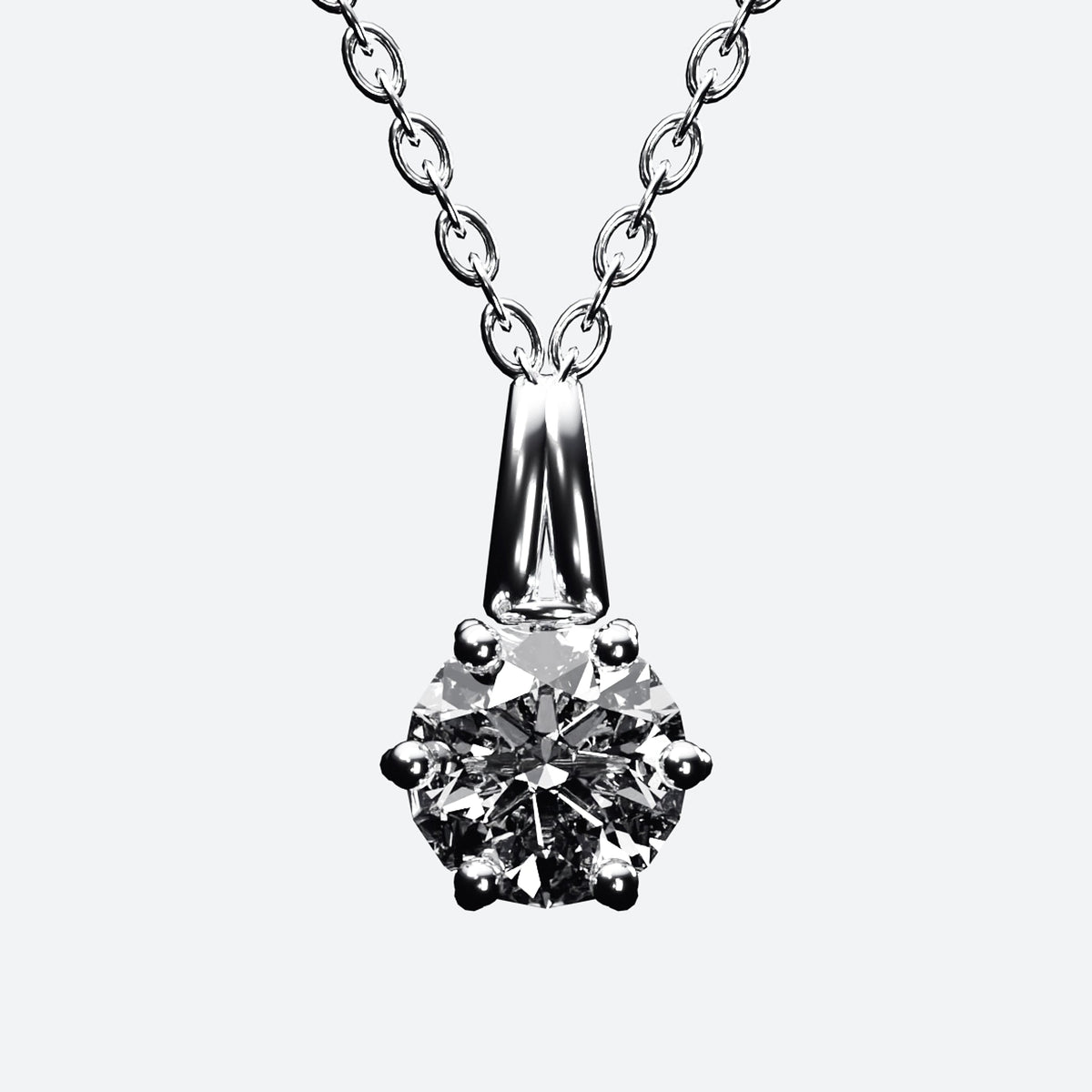
This is where the two part ways. A 1 carat diamond of good quality costs thousands of euros. A 1 ct moissanite costs a fraction of that, and our 6.5 mm solitaire pendant comes finished in 925 sterling silver with its chain.
Can you tell them apart?
By eye, most people cannot. A basic thermal diamond tester may even read moissanite as diamond, because both conduct heat well. A multi-tester that also measures electrical conductivity identifies moissanite. We always sell our stones as what they are: lab-created moissanite.
Which one should you choose?
Choose diamond if the name and its tradition matter most to you. Choose moissanite if you want the look of a large stone, more fire and a piece you can wear every day without worrying about the price. Our pendant and studs set puts three stones from the same moissanite together.